छाप र डिटिपीका लागि
Unicode to Preeti gives the legacy output Nepali print still demands
You typed clean Nepali Unicode on your phone or laptop, but the press operator, the नगरपालिका form, or the banner artist keeps saying "Preeti मा पठाउनुहोस्". This page answers that.
The unicode to preeti tool above takes the modern Nepali Unicode you already type and hands back Preeti-encoded text, the same legacy form that PageMaker pages, CorelDraw signboards, and old Word templates across Nepal were built to read. युनिकोडमा टाइप गर्नुहोस्, प्रीतिमा निर्यात गर्नुहोस्, type in Unicode, deliver in Preeti, and the layout that has worked for thirty years keeps working.
Nepal never fully migrated. Phones, Facebook, Gmail, and Google search all moved to Unicode after roughly 2008, and that is where most of the country's 30 million Nepali speakers now write. But the rooms where Nepali gets printed, the press floor, the government record office, the screen-print shop in Putalisadak, mostly stayed on Preeti. So a writer types in Unicode and a typesetter needs Preeti, every single day, and this conversion is the bridge between the two.
Where Preeti is still mandatory in Nepal
Preeti is not nostalgia; it is infrastructure. Designed in the early-to-mid 1990s, it became the default Nepali font of the desktop-publishing era and got baked into the working files of an entire industry for over 25 years. That is why a unicode to preeti converter is still a working tool and not a museum piece: the layouts it feeds are open on Nepali press desks today.
Four corners of Nepali print still hand you a Preeti requirement before they will touch your text: newspaper and magazine desks that lay out pages in PageMaker templates keyed letter-by-letter in Preeti; ward offices and the नगरपालिका whose नागरिकता slips and notice templates are locked Preeti documents; flex-print and pana shops that cut shop boards and political banners in CorelDraw around Preeti outlines; and small offset presses that print wedding cards, ब्रतबन्ध, and bhoj menus whose decorative Nepali layouts sit in Preeti and its cousins.
Unicode versus Preeti, the way it plays out in Nepal
Both encode the same Devanagari letters, but they store them so differently that they are not interchangeable, and that single fact is why a unicode to preeti step exists at all. This is the mental model every junior typesetter learns in their first week, covering the five differences that decide which format a job needs.
| What you care about | Nepali Unicode | Preeti (legacy) |
|---|---|---|
| How letters are stored | Devanagari code points in the U+0900 to U+097F block | glyphs parked on roughly 90 ASCII byte positions |
| Shows on a phone or website | Yes, with no extra font on any modern device | No, the device needs the Preeti font first |
| Searchable and copy-pasteable online | Yes, Google and Ctrl+F find the words | No, search reads it as broken Latin |
| Lands in a press template | Breaks the legacy layout | Flows straight into PageMaker, CorelDraw, old Word |
| Font family it belongs to | one universal standard for all of Devanagari | Preeti, plus Kantipur, Sagarmatha, PCS Nepali |
Why selecting "Preeti" on Unicode text never works
Unicode assigns every Nepali letter a fixed identity inside the 128 code points of the U+0900 to U+097F Devanagari range, क is always U+0915, no matter the font. Preeti, an 8-bit design, instead borrows the ASCII byte slots that normally hold a, b, c, and the punctuation keys, mapping Devanagari onto about 90 of them. A unicode to preeti converter simply walks each Devanagari code point and writes back the matching ASCII byte, which is the one move a manual font change can never do.
So the two systems disagree about what the underlying bytes mean. Pick the Preeti font on Unicode text and you ask it to draw shapes for code points it has no slots for; the result is gibberish Roman letters. A real unicode to preeti step re-encodes the text into Preeti's byte positions first, and only then does choosing the Preeti font reveal correct Nepali. That single fact explains most "my Nepali turned to English" complaints.
What a clean conversion protects
A faithful unicode to preeti output keeps the parts of Nepali that break most easily: the 12 vowel matras (े, ै, ो, ौ and the rest), the half-letters and conjuncts like र्, क्ष, and ज्ञ, and the 10 Devanagari digits ० to ९ that carry dates, amounts, and citizenship numbers. On a नागरिकता certificate or an exam mark-sheet, one mangled digit is a real problem, so a conversion that holds these steady is the whole point. Preeti also shares its byte map with at least 3 sibling fonts, Kantipur, Sagarmatha, and PCS Nepali, so the same output usually drops into those layouts too.
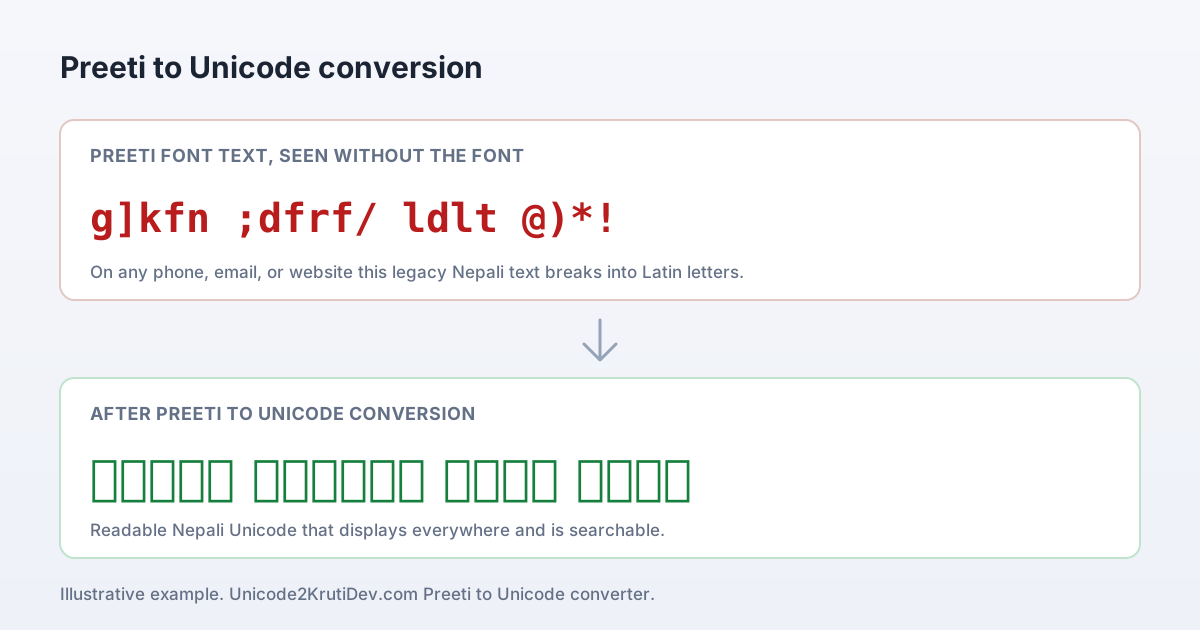
How to convert unicode to preeti, step by step
- Paste your readable Nepali Unicode into the input panel above, or type it directly, the conversion is free and needs no signup.
- Read the Preeti output the moment it appears on the right, there is no length limit, so even a 1000-word notice converts at once.
- Copy the output, or download it as a Word or plain-text file to carry to the press.
- Paste into Word, PageMaker, CorelDraw, Photoshop, or whichever program the job lives in.
- Select that pasted text and apply Preeti, or the exact legacy font name the file or printer specified.
- Proof names, dates, matras, and conjuncts against your Unicode draft before it goes to plate or submission.
What this is checked against
Nepali is written in Devanagari, so the standards below define the modern Unicode side, while the script and computing history explain why Preeti still owns the press.